Slide and Grip knot that takes strain in only one direction.
Klemheist Knot
Slide and Grip knot that takes strain in only one direction.
 |  |
1
 |  |  |  |  |
To Step use Arrow Keys ( ). Set Speed using 1 – 5.
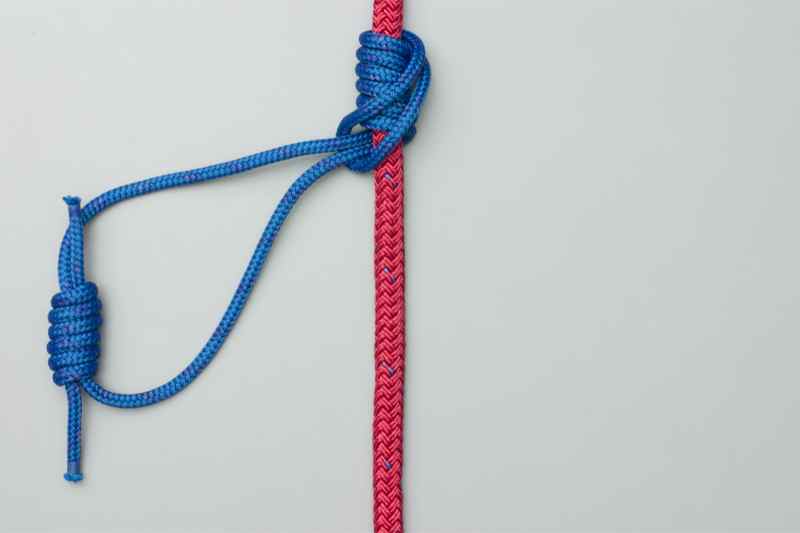
Use a piece of cord formed into a loop. Pass the loop around the main rope. Make three complete turns, laying each turn on neatly. Pass the rest of the cord through the loop and pull it back down in the direction of the expected load.
History: The Klemheist Knot (or Machard Knot) is a derivative of the original Prusik knot. It also appears to be identical to the knot described by Ashley for securing a loop to a vertical pole (ABOK # 1762, p 299). However, Ashley did not name this knot and did not describe the slide and grip feature.
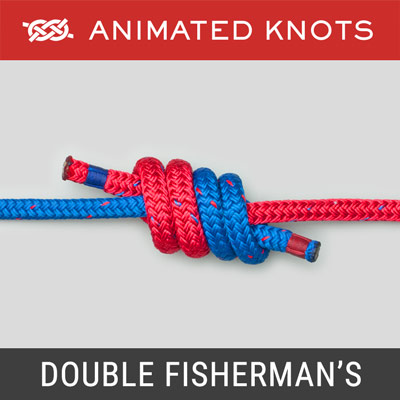
Structure: The Klemheist Knot requires a “Prusik Loop” which is constructed by joining the two ends of a length of rope using a Double Fisherman’s or a Triple Fisherman’s.
Slide and Grip Knots: There is a large family of “Slide and Grip” knots. It is not practical to show them all. The Klemheist is a good example of a knot intended for a load in one direction only. Below are three other well-known related one-direction Slide and Grip Knots:
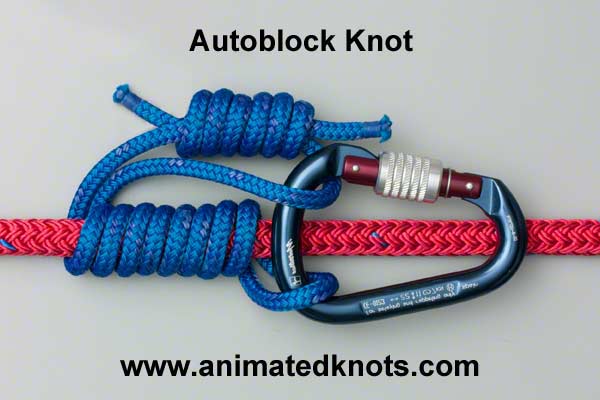
The Autoblock Knot (French Prusik Knot, or Machard Tresse Knot) employs a carabiner to join the two ends of the loop. This can be valuable in a rescue if it is necessary to release the knot while still loaded. Never grip the knot to apply load as this can initiate slipping.
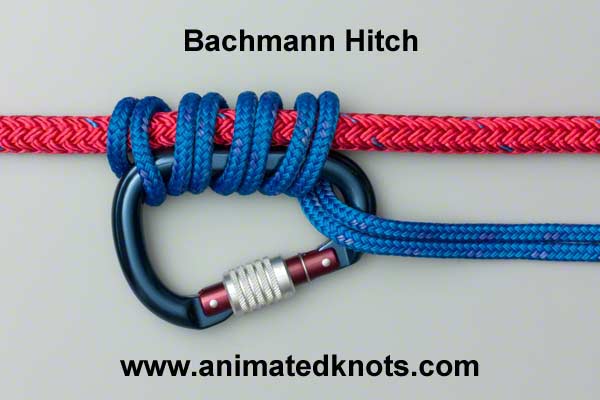
The Bachmann Hitch Knot performs a similar function but incorporates the locking carabiner into the hitch. Here the warning is the reverse: never grip the carabiner to apply load as this can initiate slipping.
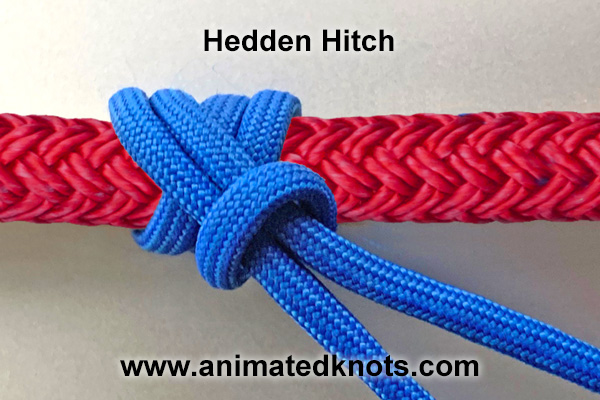
The Hedden Hitch (a.k.a. the Kreuzklem or Hedden Knot) is often described as an “upside-down” Klemheist – the bight taking the load wraps from the top of the coils – not the bottom. Chet Hedden described it in Summit Magazine, 1960. It is described as more reliable than the Klemheist and is usually shown with one less spiral turn.
Variations: With the Klemheist Knot, and the knots above, the number of turns should be increased or decreased to suit the ropes and the conditions, i.e., before using any Slide and Grip knot, test it to see that it both grips and releases well.
Rope Size: These knots must be made using a rope smaller than the load bearing rope, e.g., 5 or 6 mm cord around the climbing rope. The effectiveness of these knots diminishes as the sizes of the two ropes approach each other.