Simple wrapping hitch used in rescue work or rappelling.
Tensionless Hitch
Simple wrapping hitch used in rescue work or rappelling.
 |  |

1
 |  |  |  |  |
To Step use Arrow Keys ( ). Set Speed using 1 – 5.
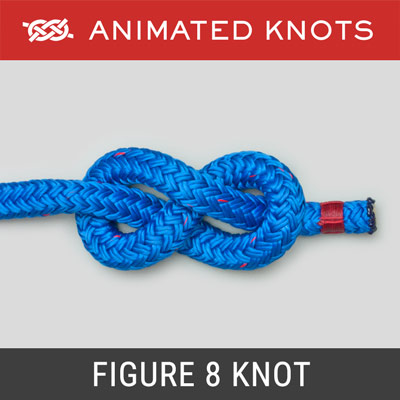
Prepare sufficient rope to make 3 or 4 turns around the post. Make a Figure 8 Loop in the end and attach a carabiner. Wrap the rope around the post. Make sure there is sufficient slack and clip the carabiner to the standing end. A kink in the standing end is an error.
Uses: The Tensionless Hitch shares a critically important feature with the Round Turn and Two Half Hitches. It is used to gain secure control of a loaded line by wrapping the rope around a post or tree several times. This is the key to the safe handling of heavy loads. Ashley described a knot employing the same principle but provided no name for it (Ashley ABOK #2047, p 332). In his example he completed the knot with two half hitches tied around the standing end.
Similar Knot:
Another similar knot is the Lighterman’s Hitch – which starts with turns wrapped around a post and is completed with alternating turns enclosing the standing end. Of these two knots we prefer the Lighterman’s because it exerts less rotational force on the post.
Advantages:
An exception might be a rope loaded to near breaking point because the Tensionless Hitch is claimed to preserve most of the rope’s breaking strain. However, this knot is nearly always used to support critical loads, i.e., people. The required safety factor renders this advantage more theoretical than practical. More plainly, if you’re that worried, choose a larger rope.
Number of Turns: The diameter of the post or tree selected should be at least eight times the diameter of the rope. Descriptions of the Tensionless Hitch indicate that the number of turns used may be increased when the post is smooth and polished. Confusing language describes the number of turns. If a rope has made a single “wrap”, it has been passed behind a post, and then knotted to itself; it has NOT made “one Round Turn”. Two “wraps” for a climber is called “One Round Turn” in boating. In the animation the rope wraps around the pole three times making “two round turns”.
Tying it: A Figure 8 Loop in the end is clipped to the standing end with no tension; hence the name “tensionless”. The animation shows a carabiner completing this knot. However, the tail can also be secured directly to the standing end using Half Hitches or a Figure 8 Follow Through.
Nomenclature: The name “Tensionless” has been deprecated. However, suggestions for some alternative, e.g., “High Strength Tie-Off”, or “Multi-Wrap Anchor”, have not gained favor – for the obvious reason that “Tensionless” is in widespread use.