Slide and grip knot used for ascent and descent.
Blake’s Hitch
Slide and grip knot used for ascent and descent.
 |  |
1
 |  |  |  |  |
To Step use Arrow Keys ( ). Set Speed using 1 – 5.
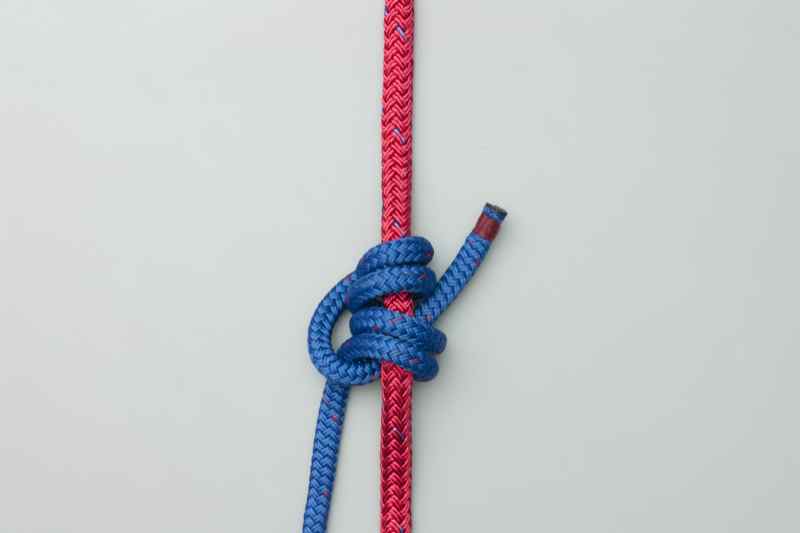
Wrap the end of the line four times around the climbing rope. Bring the end back down, around itself, and tuck it behind the climbing rope and under the first two turns so that it exits in the middle. Tighten to achieve a tight, neat, knot.
Uses: Blake’s Hitch is a Friction, or Slide and Grip, hitch. It is used by arborists for ascent and descent. Like other Slide and Grip Knots, the strain should only be taken on the line below the hitch. Blake’s Hitch itself should not be used for traction because holding the knot and pulling directly on it loosens the knot and allows descent – unexpected and uncontrolled.
Warning: For the Animation, the end was left short. For critical loads, e.g., when Climbing, the end must be left much longer.
Tying It: In practice, when tying the Blake’s Hitch, it is an advantage to wind the first two turns while your thumb is inserted up alongside the climbing rope. This maintains a pathway to make it easier to thread the line later. Note: This final threading must pass behind the main rope as shown.
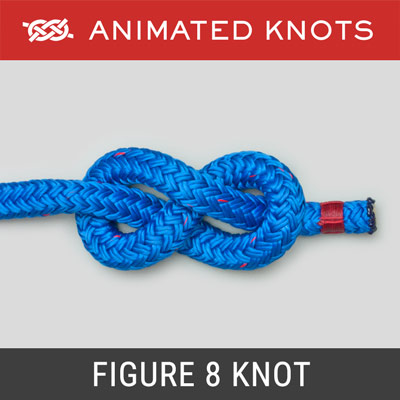
Additional Security: For photography, the free end has been kept short. However, in practice the end should be kept long. Some writers used to suggest the addition of a stopper knot for security, e.g., a Double Overhand or a Figure 8.
History: Blake’s Hitch was first described by Heinz Prohaska in an Austrian Guides Periodical in 1981 and then again in the Nylon Highway #30 in May 1990. However, Jason Blake described it in a letter to the Arbor Age in 1994. It is now widely known as Blake’s Hitch and this name is used here.
Pros and Cons: Like the Rolling Hitch, Blake’s Hitch has the advantage that it can be tied in the end of a piece of rope instead of requiring a Prusik Loop. In practice it is a stable knot which does not creep or roll along the rope.